Nigeria's Unified Healthcare Ecosystem — Complete Documentation
Nigeria's Unified Healthcare Ecosystem
Mission: To connect Nigerians with their complete health records across all hospitals in one secure, digital platform.
Vision: A Nigeria where every citizen has instant access to his complete medical history, regardless of where he received care – using a simple plastic card with a QR code.
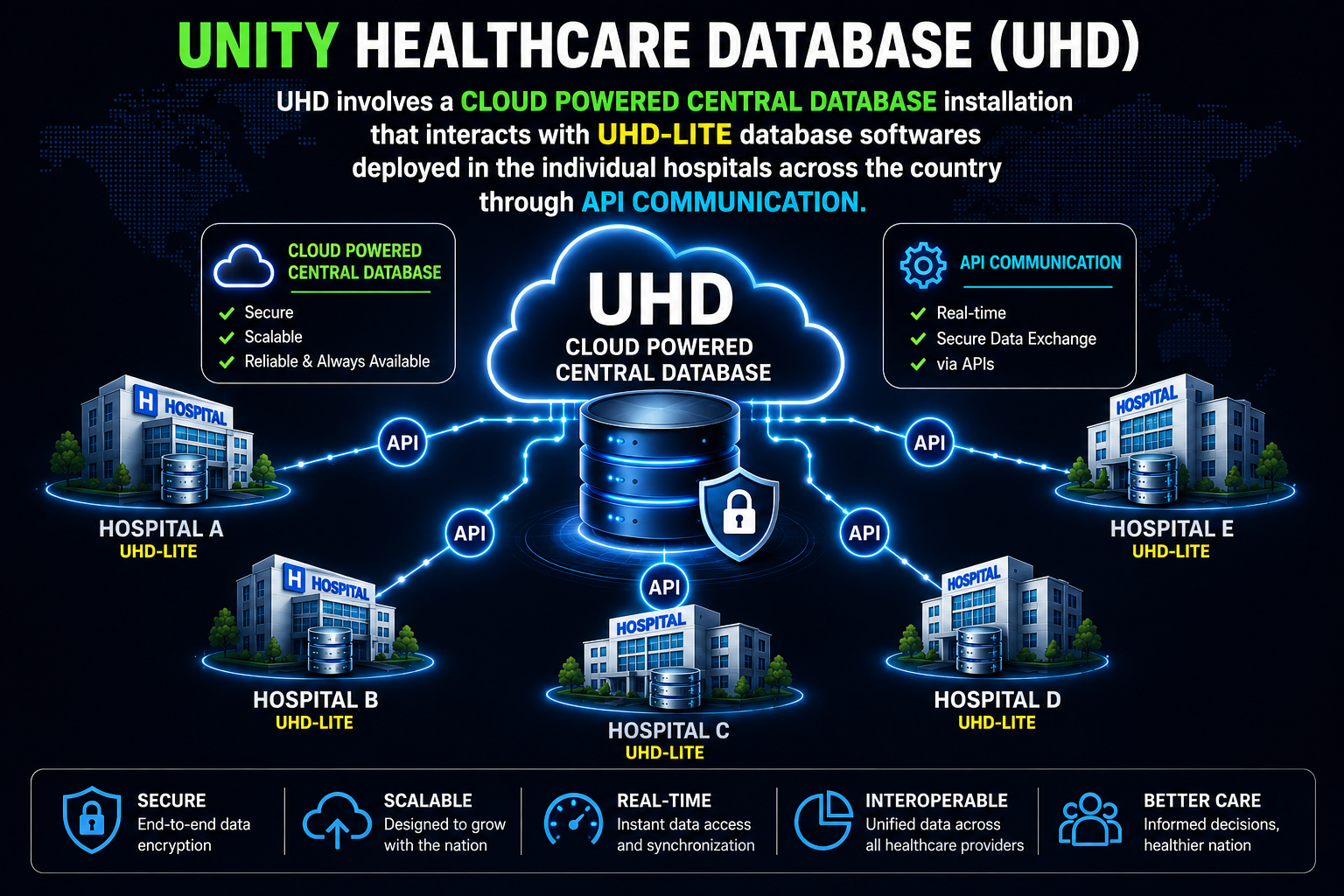
Overview: Unity Healthcare Database (UHD) is a complete, interoperable health data platform that connects patients, doctors, nurses, staff, hospitals, and administrators. It creates Nigeria's first unified healthcare ecosystem where medical records follow patients wherever they go.
No Central Database Exists
Nigeria does not have a unified health database. Each hospital operates in isolation. A patient's medical history is locked inside whichever hospital he visited. There is no national system to connect these scattered records.
Nigeria's healthcare system is disconnected. Patients pay twice for the same tests, emergency care is compromised, and lives are at risk. A unified health database is urgently needed.
UHD connects all stakeholders in one seamless platform through four integrated components:
Nigeria's first national medical records unification platform.
A physical plastic card similar to a bank card that contains:
1. Hospital registers patient – system generates unique QR code + PIN
2. Hospital prints card on plastic card
3. Patient receives card
4. Patient scans QR code with phone
5. Patient enters 4-digit PIN
6. Patient accesses all his medical records instantly
What Hospitals Install
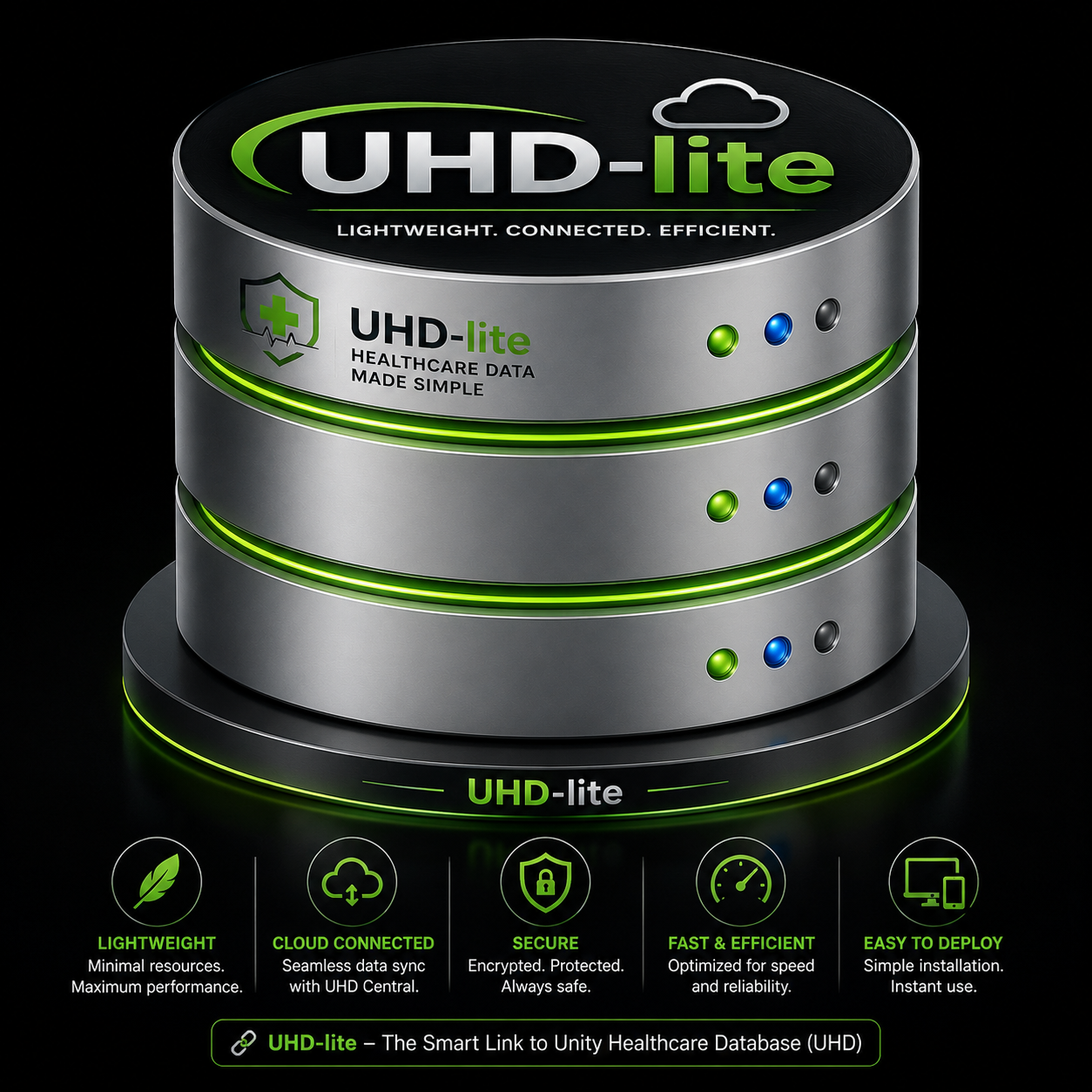
UHD-Lite is a lightweight software package that any hospital can install on its own server. It creates a secure bridge between your database and the central UHD platform.
No changes to your current workflow are required. Patient consent is always required before any data is shared. Works with most EMR systems via API. For hospitals still using paper records, we can digitize existing files.
A comprehensive healthcare marketplace platform that connects health professionals, employers, and vendors.
Facebook, WhatsApp, Twitter/X, LinkedIn, Telegram, Email, Copy link to clipboard, and Health Pulse sharing.
The social and community platform where health professionals connect, share experiences, insights, and stories with the healthcare community.
This package includes the software only. Your IT team installs and configures the system on your server.
We will install UHD-Lite on your server and integrate it with your existing patient database, and train your staff. Includes 24 hours technical support. If you don't have existing database or wish not to integrate UHD-lite with your existing database, we will install UHD-lite on a separate server. Note that UHD-LITE comes with a free domain name and free one year hosting subscription.
This includes the software download and installation, database integration, and staff training – everything you need to go live, and possible expansion of the software into a full-blown hospital digitalization which includes every event in your hospital including accounts, products sales, medical and social services.
Not less than 30% deposit required to begin installation. Balance due upon successful go-live. On site payment via flutterwave (UHD.com.ng/UHD-lite)
A: No. UHD Central only stores patient identities and consent links. The actual medical records remain in your hospital's database. UHD fetches them in real time only when the patient gives permission.
A: UHD-Lite can integrate via API. If your EMR has no API, we can work with you to export data or create a custom bridge between the systems.
A: All communication is encrypted over HTTPS. API keys are required for every request. Patients control their own consent and can revoke access at any time. Full audit logs track all data access.
A: Yes. They can also use a computer or tablet. The QR code can be scanned from a printed paper card, though plastic is recommended for durability.
A: We provide lifelong online support with every package.
A: When you register a patient, the system automatically generates a unique Patient ID, a 4-digit PIN (the first 4 digits of the ID or random), and a QR code.
A: Yes. Contact us for a free live demo and a 14-day free trial on a test server – no obligation.
A: A replacement card can be printed for a nominal fee. The PIN can be reset by an administrator if needed.
A: Yes. Nurses have their own portal with features for recording vital signs, managing assigned patients, and chatting with doctors.
| Feature | UHD | Typical Software |
|---|---|---|
| One-time fee | Yes | Monthly subscription |
| Plastic QR cards | Yes | No physical card system |
| Patient self-service portal | Yes | Limited or none |
| Records across multiple hospitals | Yes | Isolated to one facility |
| Doctor-patient chat | Yes | No |
| Virtual consultations | Yes | No |
| Nurse and staff portals | Yes | Limited roles |
| Admin approval system | Yes | No |
| Free user tier | Yes | No patient acquisition funnel |
| National network | Yes | Works only within one hospital |
| AI Clinical Assistant | Yes | No |
| Feature | UHD | Paper Records |
|---|---|---|
| Records never lost | Yes | Easily damaged or destroyed |
| Instant access | Yes | Manual filing and searching |
| Durable | Yes | Tears and fades over time |
| Works nationwide | Yes | Stays in one hospital |
| Patient control | Yes | Patient has no access |
The UHD Difference
Unity Healthcare Database represents a paradigm shift in Nigerian healthcare delivery. By creating a unified ecosystem that connects patients, healthcare professionals, employers, and vendors, UHD addresses the fundamental challenges facing African healthcare.
Unity Healthcare Database (UHD), created by Fulgent Digital Clinic, is not just a record system—it is a healthcare revolution. For the first time in Nigeria's history, patients' complete medical history follows them wherever they go. No more missing files. No more repeated tests. No more fragmented care. Just one unified record for every Nigerian.
Join the growing network of hospitals using UHD to unify patient records, improve care, and save lives.